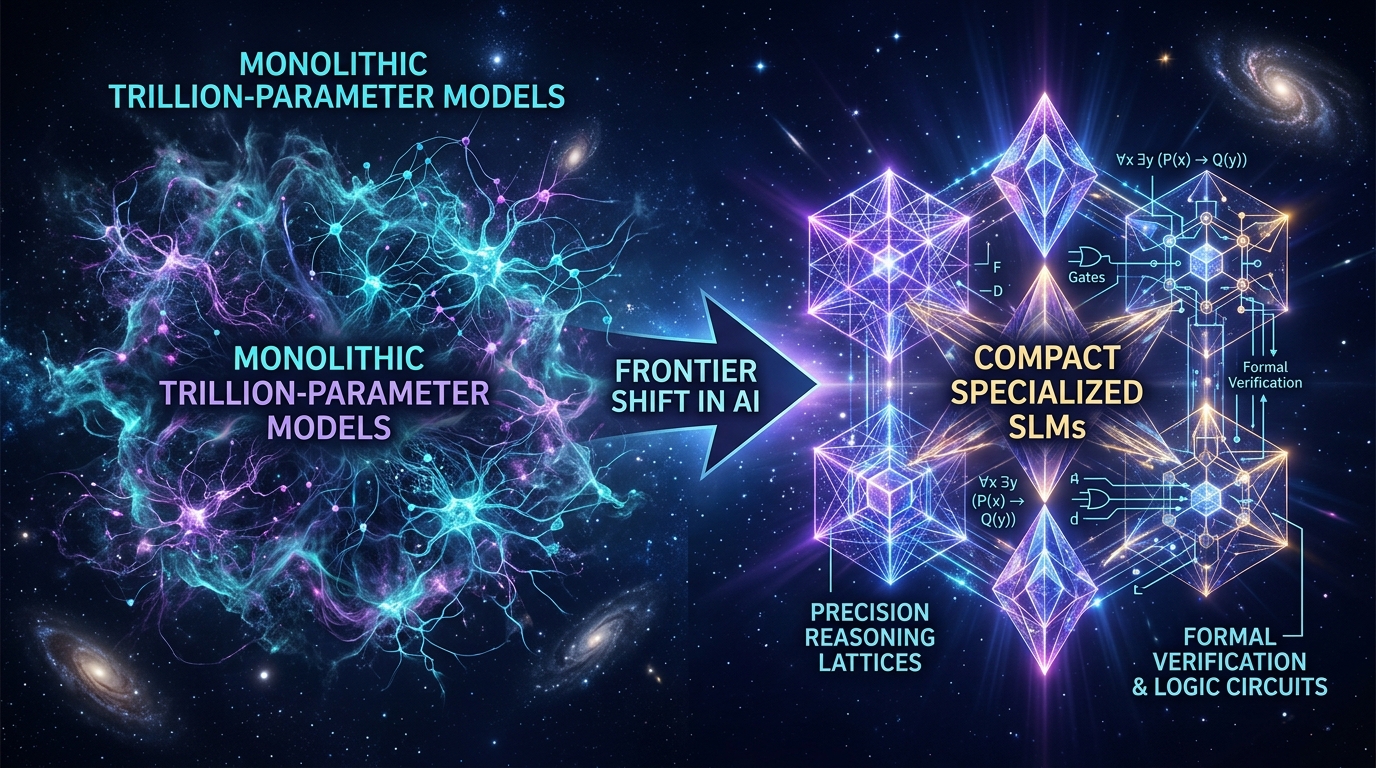
The era of blind parameter scaling is hitting economic, latency, and environmental thresholds. We review the latest breakthrough research in test-time compute, synthetic reasoning traces, and deterministic verification that allow 3B-parameter models to outperform legacy 70B behemoths on mission-critical tasks.
For nearly four years, the prevailing dogma across machine learning labs was straightforward: double the parameters, feed more petabytes of internet tokens, and emergent intelligence will solve every domain problem. But in real-world enterprise software, this brute-force approach has encountered hard thermodynamic and financial walls.
Paying substantial API premiums to query a 500-billion-parameter cloud cluster with a 4-second Time-to-First-Token (TTFT) makes automated high-throughput production workloads economically unsustainable. Furthermore, enterprise risk officers cannot tolerate stochastic non-determinism in mission-critical applications like tax audits or regulatory compliance.
Recent frontier AI research demonstrates that model intelligence is not purely a function of pre-training size, but of test-time compute allocation. By integrating Monte Carlo Tree Search (MCTS) and Process Supervision Reward Models (PRMs), a compact 3B-to-7B parameter network can explore alternative hypothesis branches, verify intermediate logic steps, and self-correct prior to returning an answer.
The most profound architectural breakthrough in 2026 is the convergence of statistical neural representations with classical symbolic logic engines. Pure neural networks excel at messy unstructured data—parsing handwritten scans, colloquial speech, and ambiguous legal prose. However, they lack innate deductive proofs. By establishing a bi-directional interface where the neural engine generates formal intermediate representations that are subsequently verified by deterministic theorem provers, enterprise platforms completely eliminate hallucination risks.
Smaller, faster, deterministic intelligence deployed directly alongside your transactional databases is the defining paradigm of the next enterprise decade.